

Content Creator
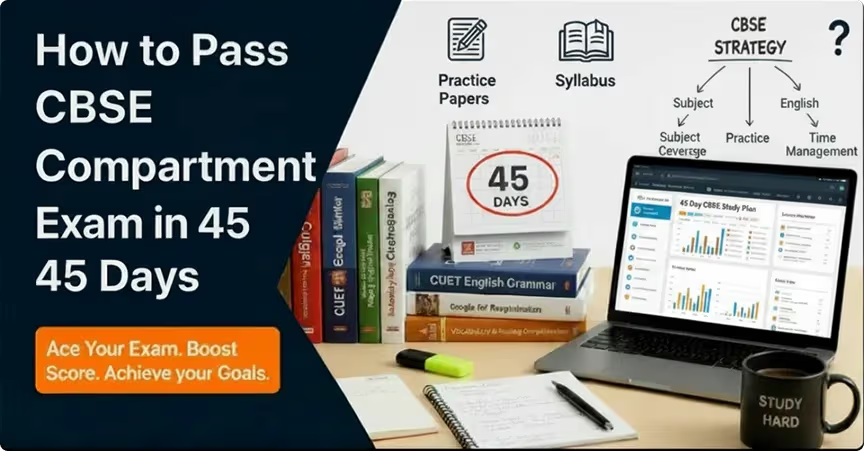
If you have received a compartment in the CBSE exam CBSE 12th Supplementary Exam 2026, it may feel stressful, but it is just a small setback and not the end of your journey. Every year, many students clear the CBSE Compartment Exam 2026 CBSE 12th Supplementary Exam 2026 by following the right strategy and focused preparation. With 45 days in hand, you still have enough time to study smartly and improve your performance. Below is a simple and effective 45-day study plan to help you prepare in the right way and clear the exam with confidence.
CBSE Compartment Exam is a second chance for students who do not pass one or two subjects in Class 10 or Class 12. It helps you save your academic year and improve your result. CBSE exam has the same syllabus, question paper style, and marking system as the main board exam. The level of difficulty also stays almost the same. The main difference is your preparation and focus. Students who appear for this exam are those who get a compartment in one or two subjects and need to clear it to move ahead in their studies.
| Key Element | Details |
|---|---|
| Eligibility | Students with compartment in one or two subjects |
| Classes Covered | Class 10 and Class 12 |
| Purpose | Save one academic year and improve result |
| Syllabus | Same as board exam |
| Exam Pattern | Same as main exam |
| Difficulty Level | Almost same as board exam |
| Time Available | Around 45 to 60 days |
| Benefit | Chance to pass and continue studies |
CBSE Compartment Exam is not harder than the board exam. It follows the same CBSE syllabus, pattern, and marking system. The level of questions also stays similar. What really decides the difficulty is your preparation and understanding of the subject. The good part is that you already know your weak areas. You can focus on those topics and improve them in a better way. This gives you an advantage compared to your first attempt. The exam starts to feel difficult only when there is no proper plan, less practice, or last-minute study. With a clear study routine, daily practice, and regular revision, the exam becomes much easier to manage. Use these 45 days in a smart and focused way, and you can pass with confidence.
Students do not apply directly in most cases. The application process is handled through schools.
Steps usually include:
This 45-day plan is designed to help you study in a clear and organised way without feeling confused or stressed. Instead of random study, you follow a step-by-step approach where each week has a specific goal. You start with understanding the syllabus and your weak areas, then move to concept building, focused practice, and finally full revision. The plan keeps a balance between learning and practice so you do not feel overloaded. If you follow it daily with consistency, it can help you cover the full syllabus, improve your weak points, and build enough confidence to perform well in the exam.
Week 1: Diagnose and Plan (Days 1–7)
The first week focuses on understanding your syllabus, identifying weak areas, and setting a clear study plan. You prepare your resources and build a routine that you can follow daily without burnout.
| Focus Area | What to Do |
|---|---|
| Syllabus Check | Go through the full CBSE syllabus and mark all topics |
| Weak Areas | Identify topics where you lost marks earlier |
| Study Plan | Create a daily timetable of 6 to 8 hours |
| Study Pattern | Use 90-minute sessions with short breaks |
| Resources | Collect NCERT books and previous year papers |
| Goal | Build a strong and realistic study base |
Week 2: Foundation Building (Days 8–14)
This week focuses on covering NCERT completely and building strong basic concepts in every chapter.
| Focus Area | What to Do |
|---|---|
| NCERT Reading | Study all chapters carefully from start to end |
| Notes Making | Write short and clear notes while studying |
| Science Focus | Learn diagrams, definitions, and equations |
| Maths Focus | Solve all NCERT examples before exercises |
| Social Science Focus | Remember dates, events, and maps |
| Goal | Complete full syllabus understanding |
Week 3: Deep Dive Into Weak Areas (Days 15–21)
This week focuses on improving weak topics through extra practice and better understanding.
| Focus Area | What to Do |
|---|---|
| Weak Topics | Spend more time on difficult chapters |
| Practice Method | Understand, write, and practice questions |
| Reference Books | Use extra books for better clarity |
| Time Management | Do not get stuck on one topic too long |
| Revision | Revisit difficult concepts again |
| Goal | Turn weak areas into strengths |
Week 4: Practice and Mock Tests (Days 22–30)
This week shifts focus from learning to solving papers and improving exam performance.
| Focus Area | What to Do |
|---|---|
| Previous Papers | Solve CBSE compartment papers |
| Time Practice | Attempt papers in real exam timing |
| Mistake Analysis | Check answers and learn from errors |
| Concept Revision | Revise topics where mistakes happen |
| Practice Frequency | Solve one paper every two days |
| Goal | Improve speed and accuracy |
Week 5: Acceleration and Refinement (Days 31–38)
This week focuses on improving accuracy and fixing repeated mistakes.
| Focus Area | What to Do |
|---|---|
| Error Review | Go through all mistakes from mock tests |
| Important Questions | Practice common and scoring questions |
| Language Practice | Write letters, essays, and reports |
| Daily Reading | Solve unseen passages for practice |
| Quick Notes | Make short notes and flashcards |
| Goal | Increase accuracy and confidence |
Week 6: Full Revision Mode (Days 39–45)
The final week focuses on revision and staying calm before the exam.
| Focus Area | What to Do |
|---|---|
| Revision | Revise notes and important topics daily |
| NCERT Review | Go through key chapters again |
| Mock Tests | Attempt one or two final papers |
| Health | Take proper sleep and eat well |
| Stress Control | Stay calm and avoid overthinking |
| Final Day | Do light revision and rest properly |
| Goal | Enter exam with full confidence |
The right study material makes your preparation simple and clear. Start with NCERT textbooks, as they cover the full syllabus and form the base of the exam. After that, use a few trusted books and papers for practice and better understanding. Sample papers and previous year papers show the exam pattern and help you manage time well. Do not use too many books, as it can create confusion. Keep your resources limited and focus on regular practice.
| Resource Type | Recommended Material | How It Helps |
|---|---|---|
| Main Book | NCERT Textbooks | Clear concepts and full syllabus coverage |
| Sample Papers | CBSE Official Sample Papers | Clear idea of exam pattern and questions |
| Previous Papers | Past Compartment Papers | Better practice and time control |
| Maths Practice | RD Sharma, RS Aggarwal | More questions for strong practice |
| Physics Concepts | HC Verma, Pradeep’s Physics | Better concept clarity |
| Chemistry and Biology | Pradeep’s Books | Clear understanding of topics |
| Study Strategy | Limited Resources | Less confusion and better focus |
Study for about 6 to 8 hours every day. Focus on quality, not just time. Do not sit for long hours without breaks. Divide your study time into small sessions so you stay fresh and focused. Start your morning with the most difficult subject and study for about 2 hours. Take a short break, then study your second subject for 1.5 to 2 hours. Spend time on practice questions or solve papers a fter lunch. In the evening, revise what you studied and practise writing for language subjects. Keep Sundays light. Use this day for mock tests and to check your weak areas instead of new topics.
It is normal to feel low after the result, but you can stay motivated with the right approach. Focus on your progress and keep your mindset positive throughout these 45 days.
Set Small Goals
Break your syllabus into weekly targets. Focus on one chapter or topic at a time instead of the full syllabus.
Celebrate Small Wins
Every completed chapter, test, or revision is progress. Acknowledge these small achievements to stay confident.
Avoid Comparison
Do not compare your result with others. Your journey is different, and this is your chance to improve.
Track Your Progress
Keep a checklist of topics and mock test scores. This helps you see your improvement clearly.
Stay in a Positive Environment
Talk to supportive people. Avoid social media or anything that creates stress or distraction.
Stay Consistent
Follow your study plan daily. Even small daily effort leads to big results over time.
CBSE 12th Supplementary Exam 2026 is an additional chance given to students who are unable to pass one or more subjects in the main CBSE Class 12 board examination. This exam helps students save their academic year without repeating the full class again.
It is conducted by the Central Board of Secondary Education (CBSE) after the main result declaration.
CBSE releases the supplementary exam schedule after the main result announcement. The timeline is usually short, so students must stay updated.
| Event | Expected Timeline |
|---|---|
| Application start | June 2026 (Expected) |
| Admit card release | July 2026 |
| Exam date | July–August 2026 |
| Result declaration | August 2026 |
The syllabus for the CBSE supplementary exam remains the same as the main Class 12 board exam syllabus. Students do not need to study extra topics.
The admit card is a mandatory document for appearing in the exam. It is released by CBSE through schools or official portals. Students must carefully follow exam hall instructions to avoid disqualification.
| Point | Details |
|---|---|
| Admit card release | Before exam (July 2026 expected) |
| Where to get | School or official CBSE portal |
| Documents required | Admit card + School ID |
| Exam rules | Reach early, follow instructions |
| Allowed items | Stationery only |
The supplementary result is declared after evaluation of answer sheets. Students must secure minimum passing marks to clear the exam.
| Criteria | Details |
|---|---|
| Passing marks | 33% in each subject |
| Result mode | Online |
| Checking method | Roll number and school details |
| Final document | Original marksheet via school |
A compartment is not the end of your journey, it is a second chance to improve your result. These 45 days give you enough time to understand your mistakes and prepare in a better and smarter way. Focus on NCERT, follow a clear study plan, practise regularly, and revise all important topics. Stay consistent with your routine and use each day with purpose. Do not let stress or fear affect your preparation. Keep your focus strong and trust the effort you put in every day. Your result does not define your future. What matters is how you use this opportunity to improve and move ahead with confidence.
© 2026 Nuvora Education Private Limited. All rights reserved.