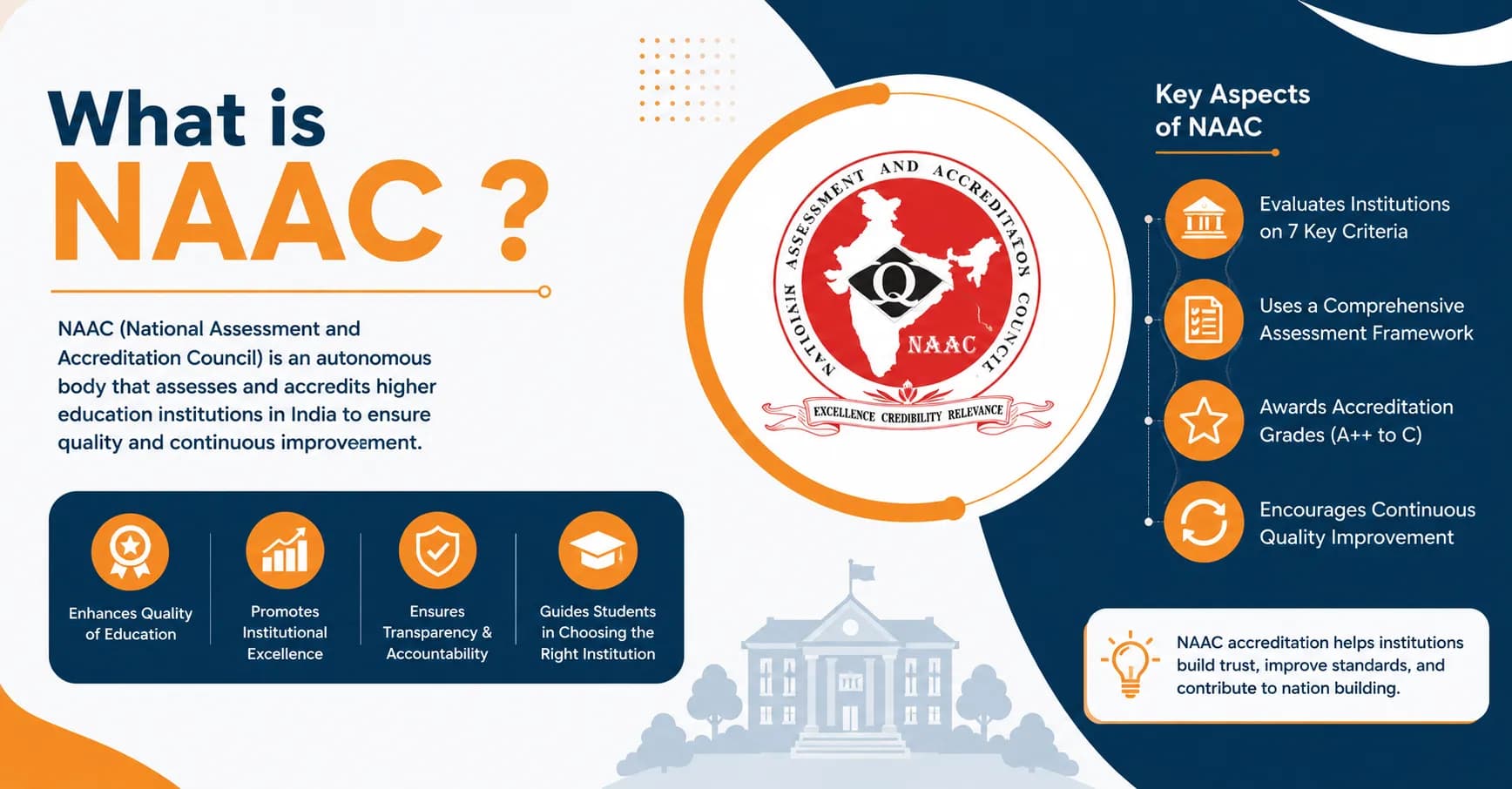

In case the students are going to get enrolled in higher studies in India, they may encounter the concept of NAAC Accreditation while searching for suitable educational institutions. But what is the meaning of NAAC and importance of NAAC accreditation? The full form of NAAC is the National Assessment and Accreditation Council, which is an autonomous body set up by the University Grants Commission in order to rate and accredit the higher education institutions on the basis of academic quality, infrastructure, administration, research activities and student welfare. The NAAC accreditation with a good grade indicates that the institution ensures high-quality education standards.
NAAC, National Assessment and Accreditation Council, is an autonomous body formed by University Grants Commission (UGC) for assessing and accrediting higher education institutions of India. The main goal of NAAC is to assess the quality of educational institutions according to certain pre-set parameters like teaching-learning process, research, infrastructural facilities, governance, student support systems, and institutional values. While other regulatory bodies are concerned with recognition of institutions, the NAAC’s focus is on measuring educational quality and institutional effectiveness. This results in an accreditation grade awarded by the NAAC that helps in identifying the quality of institutions. Currently, NAAC accreditation is one of the most important indicators of quality for higher education institutions in India.
NAAC full form is National Assessment and Accreditation Council.
It is an autonomous body established by the University Grants Commission to assess and accredit colleges and universities based on their academic and institutional performance. NAAC accreditation encourages institutions to improve quality, adopt best practices, and maintain transparency in higher education.
Knowledge about the basic facts of NAAC would enable the students to understand how NAAC functions for the betterment of higher education. The following table provides an understanding of the establishment of NAAC, its governing body, and other facts.
| Particular | Details |
|---|---|
| Full Form | National Assessment and Accreditation Council |
| Established | 1994 |
| Established By | University Grants Commission (UGC) |
| Nature | Autonomous Body |
| Headquarters | Bengaluru, Karnataka |
| Governing Body | University Grants Commission |
| Purpose | Assessment and Accreditation of Higher Education Institutions |
| Accreditation Validity | Generally 5 Years |
| Official Website | naac.gov.in |
With the rapid growth of higher education in India, it was necessary to assess not just the quantity of the institutes but also the quality of education imparted. For this purpose, the University Grants Commission set up NAAC as an independent quality assurance agency in 1994. The establishment of NAAC was done with a view to improving continuously the standards of teaching, research, administration, infrastructure, and performance of the institute. Check below the objectives of NAAC:
Since its establishment, NAAC has significantly contributed to improving the quality of higher education in India. Over the years, it has introduced new assessment frameworks, grading systems, and quality benchmarks to meet the changing needs of educational institutions.
| Year | Development |
|---|---|
| 1994 | NAAC established by the University Grants Commission. |
| 1998 | Large-scale accreditation of higher education institutions began. |
| 2007 | Revised accreditation methodology introduced. |
| 2013 | Grading system further strengthened with revised criteria. |
| 2017 | Revised Accreditation Framework (RAF) launched with greater emphasis on ICT-based assessment. |
| 2020 | Quality assessment aligned with the National Education Policy (NEP) 2020. |
| 2024–2026 | Continued reforms focusing on digital assessment, transparency, multidisciplinary education, and institutional excellence. |
NAAC uses a systematic approach for assessing institutions of higher education. The colleges/universities apply for accreditation voluntarily and go through several phases of the assessment. These include documentation checking, quantitative and qualitative analysis, team visit (if necessary), and finally grading as per the criteria for quality set by NAAC. Check below the NAAC a ccreditation process:
Step 1: Institution applies for NAAC accreditation.
Step 2: Institutional Information is submitted through the NAAC portal.
Step 3: Data Validation and Verification (DVV) is conducted.
Step 4: Student Satisfaction Survey (SSS) is completed.
Step 5: Peer Team evaluates the institution.
Step 6: NAAC awards a grade based on the institution's performance.
NAAC operates through an efficient administrative system involving various governance and management committees, expert committees, peer review committees, and academics who contribute to maintaining transparency and consistency in the process of accreditation. Check below the o rganizational structure of NAAC:
| Position | Responsibility |
|---|---|
| General Council | Provides overall policy direction. |
| Executive Committee | Makes decisions related to accreditation and administration. |
| Director | Heads the organization and oversees operations. |
| Academic & Administrative Staff | Manage assessment, accreditation, and institutional support. |
| Peer Review Team | Conducts institutional evaluations and validation. |
| Subject Experts | Assess academic quality and institutional performance. |
NAAC accreditation help students in identifying institutions of higher learning that have high-quality standards in their educational process. A good NAAC rating is an indication of dedication to academic excellence, research, infrastructure, governance, and development of the students. Accreditation has benefits for institutions in enhancing their reputation and recruitment of good students and faculty, among others. For the students, it acts as one of the main criteria when comparing different institutions. Check below the importance of NAAC accreditation:
| Benefit | Why It Matters |
|---|---|
| Quality Education | Indicates adherence to established quality standards. |
| Better Learning Environment | Reflects strong teaching and academic practices. |
| Institutional Credibility | Enhances the reputation of the college or university. |
| Student Confidence | Helps students make informed admission decisions. |
| Funding Opportunities | Accredited institutions may become eligible for various development schemes. |
| Research Growth | Encourages innovation and academic excellence. |
| Continuous Improvement | Motivates institutions to regularly enhance performance. |
| Global Recognition | Improves institutional reputation at national and international levels. |
National Assessment and Accreditation Council (NAAC) is an essential organization that assists in enhancing the quality of higher education in India. It does not regulate universities but assesses them on the basis of their performance. In this way, NAAC ensures that there is improvement in quality in higher education institutions. Check below the major functions of NAAC:
| Function | Purpose |
|---|---|
| Assessment of Institutions | Evaluates the quality and performance of colleges and universities. |
| Accreditation | Awards accreditation grades based on institutional performance. |
| Quality Assurance | Promotes continuous quality improvement in higher education. |
| Development of Best Practices | Encourages institutions to adopt innovative academic and administrative practices. |
| Research Promotion | Supports research culture and innovation through quality evaluation. |
| Student-Centric Education | Evaluates teaching-learning processes and student support systems. |
| Institutional Governance | Assesses leadership, governance, and administrative effectiveness. |
| Transparency & Accountability | Promotes ethical practices and institutional responsibility. |
| Internal Quality Assurance | Encourages institutions to establish Internal Quality Assurance Cells (IQAC). |
| Quality Awareness | Organizes workshops, seminars, and awareness programmes on quality assurance. |
NAAC reviews institutions of higher education on the basis of seven different criteria. All aspects of institutions, starting from curriculum and teaching till governance, research, infrastructure and values are covered by these seven criteria. These seven criteria together make a complete evaluation of the quality of an institution.
| Criterion | Focus Area |
|---|---|
| Curriculum Aspects | Curriculum planning, design, implementation, and flexibility. |
| Teaching-Learning and Evaluation | Teaching quality, faculty, student assessment, and learning outcomes. |
| Research, Innovations & Extension | Research activities, publications, innovation, consultancy, and outreach. |
| Infrastructure & Learning Resources | Campus infrastructure, laboratories, libraries, ICT facilities, and maintenance. |
| Student Support & Progression | Scholarships, placements, mentoring, student development, and progression. |
| Governance, Leadership & Management | Institutional leadership, strategic planning, financial management, and quality initiatives. |
| Institutional Values & Best Practices | Ethics, inclusiveness, environmental sustainability, gender equity, and community engagement. |
Every institution is not eligible to directly apply for NAAC accreditation. In order to apply for NAAC accreditation, all colleges and universities should fulfill certain eligibility criteria. Fulfilling these criteria means that institutions have developed certain minimum academic and administrative systems. Check below the eligibility criteria for NAAC accrediation:
| Eligibility Requirement | Details |
|---|---|
| Recognized Institution | Must be recognized under the applicable provisions of higher education regulations. |
| Academic Programmes | Should offer regular academic programmes. |
| Operational Status | Institution should have completed the minimum period of operation prescribed by NAAC before applying. |
| Compliance | Must follow applicable statutory and regulatory requirements. |
| Institutional Data | Required documents and institutional information must be submitted through the NAAC portal. |
NAAC follows a transparent and structured accreditation process to evaluate institutional quality. The process combines quantitative data, qualitative assessment, student feedback, and expert evaluation to ensure a fair and comprehensive review. Check below the steps in NAAC accreditation process:
Step 1: Institution registers on the NAAC portal.
Step 2: Institutional Eligibility for Quality Assessment (IEQA), where applicable, and required information are submitted.
Step 3: Self Study Report (SSR) is prepared and uploaded.
Step 4: Data Validation and Verification (DVV) is conducted.
Step 5: Student Satisfaction Survey (SSS) is carried out.
Step 6: Peer Team Visit (where applicable) evaluates institutional performance.
Step 7: Final assessment is completed and the institution is awarded a NAAC grade.
NAAC Grading System assists students, parents, employers, and policymakers to assess the quality of higher education institutions. The NAAC after completing the process of accreditation then rates the institution with CGPA and an appropriate letter grade according to its performance on the basis of all seven assessment criteria. The higher grade of NAAC implies that the institution possesses high-quality academics, good governance, quality infrastructure, research and student support systems.
NAAC evaluates institutions using both quantitative and qualitative parameters based on the seven criteria for assessing institutions. According to the performance of the institution, the CGPA is determined on a four-point scale. The CGPA is further graded based on the institution's overall quality. The grading system allows students to make comparisons among colleges/universities and helps the institutions to benchmark themselves based on national quality standards. Check below the NAAC Grading System (CGPA & Grade):
| CGPA Score | Grade | Accreditation Status |
|---|---|---|
| 3.51 – 4.00 | A++ | Highest Level of Accreditation |
| 3.26 – 3.50 | A+ | Excellent |
| 3.01 – 3.25 | A | Very Good |
| 2.76 – 3.00 | B++ | Good |
| 2.51 – 2.75 | B+ | Above Average |
| 2.01 – 2.50 | B | Satisfactory |
| 1.51 – 2.00 | C | Accredited |
| Below 1.50 | D | Not Accredited |
Knowing about NAAC grades allows a student to assess the quality of the institution before joining. Although a good NAAC grade is an indication of strong performance by the institution, there are many other parameters that need to be considered.
Grade A++ is the highest recognition provided by NAAC. Institutes with this grade show excellent performance in terms of academics, research, governance, innovation, infrastructure, and student welfare. Such institutes are regarded as some of the best performing higher education institutes in India.
Any institution that receives an A+ grade has high academic standards and always excels in all the parameters used to evaluate their performance by NAAC. Such institutions normally have good faculty, good infrastructure, engage in research, and have good governance structures.
An A grade indicates very good institutional performance. These institutions provide quality education, maintain good infrastructure, encourage research, and offer strong academic support to students.
A B++ grade reflects good academic performance and institutional management. These institutions meet most quality benchmarks while continuing to improve their academic and administrative practices.
Institutions with a B+ grade provide satisfactory educational standards and comply with NAAC quality requirements. However, there may still be opportunities for improvement in research, infrastructure, or governance.
A B grade indicates that an institution meets the minimum quality standards required for accreditation. While accredited, such institutions should continue improving teaching quality, infrastructure, research, and student services.
A C grade represents the minimum accreditation level. Institutions receiving this grade satisfy the basic quality requirements but require significant improvements to achieve higher accreditation levels.
D Grade
Institutions scoring below the minimum CGPA threshold receive a D Grade, indicating that they are not accredited under the NAAC framework.
Cumulative Grade Point Average (CGPA) is determined through the assessment of institutional performance on the basis of seven NAAC criteria. Each criterion holds a specific weightage and institutional performance is assigned scores using quantified measures and quality assessment. The cumulative score is arrived at after applying weightages to arrive at the CGPA that will be the basis for accreditation grade. Check below the components considered for CGPA:
| Assessment Area | Evaluated Parameters |
|---|---|
| Curriculum | Curriculum planning, flexibility, and implementation |
| Teaching & Learning | Faculty quality, student performance, and learning outcomes |
| Research | Publications, patents, innovation, and funded projects |
| Infrastructure | Campus facilities, laboratories, libraries, and ICT |
| Student Support | Scholarships, placements, mentoring, and progression |
| Governance | Leadership, financial management, and quality initiatives |
| Institutional Values | Ethics, inclusiveness, sustainability, and best practices |
NAAC accreditation validity period is typically five years from the date of NAAC accreditation. This implies that the institution is required to maintain and enhance its performance in areas such as academics, governance, research, infrastructure, and support facilities throughout this period. After the expiry of this period, the institutions are required to apply for re-accreditation if they desire to retain their NAAC status.
| Particular | Details |
|---|---|
| Accreditation Validity | Generally 5 Years |
| Renewal | Institution must apply for re-accreditation |
| Objective | Continuous quality improvement |
| Monitoring | Institutions are expected to maintain NAAC standards throughout the accreditation period |
Students can easily verify the accreditation status and grade of a college or university through the official NAAC website. Checking the grade before admission helps ensure that the institution has undergone quality assessment and meets recognised standards. Check below the steps to check NAAC accreditation:
Step 1: Visit the official NAAC website.
Step 2: Open the accredited institutions section.
Step 3: Search using the institution's name or state.
Step 4: View the institution's accreditation status and grade.
Step 5: Check the validity period of the accreditation.
Step 6: Download the accreditation report if required.
Students find it difficult to differentiate between NAAC and UGC due to the fact that both of these entities are related to higher education in India. Nevertheless, their functions are different. The former is responsible for regulating the functioning of the universities whereas the latter provides ratings for higher education institutions. It is important to understand the difference to evaluate the legitimacy and quality of an institution. Check below the difference between NAAC and UGC:
| Feature | NAAC | UGC |
|---|---|---|
| Full Form | National Assessment and Accreditation Council | University Grants Commission |
| Established | 1994 | 1953 (Statutory in 1956) |
| Nature | Autonomous body | Statutory body |
| Established By | University Grants Commission | Government of India |
| Primary Role | Assesses and accredits institutions | Regulates and recognizes universities |
| Main Focus | Institutional quality and performance | Higher education regulation and standards |
| Result | Accreditation Grade (A++, A+, A, etc.) | University recognition and regulations |
| Importance for Students | Indicates quality of education | Confirms institutional recognition |
NAAC and NIRF have relevance to higher education in terms of the quality of education, but both have their own objectives. The NAAC assesses institutional quality and provides accreditation marks, while the NIRF (National Institutional Ranking Framework) ranks institutions according to their performance on multiple criteria. Check below the table for difference between NAAC and NIRF:
| Feature | NAAC | NIRF |
|---|---|---|
| Full Form | National Assessment and Accreditation Council | National Institutional Ranking Framework |
| Managed By | University Grants Commission | Ministry of Education |
| Purpose | Accreditation | Ranking |
| Evaluation | Institutional quality | Institutional performance |
| Result | Accreditation Grade | National Rank |
| Frequency | Generally every 5 years | Annually |
| Best For | Measuring educational quality | Comparing colleges and universities |
Both NAAC and NBA (National Board of Accreditation) deal with quality assurance in their own way. While NAAC focuses on institutional accreditation, NBA is concerned with technical and professional programs.
| Feature | NAAC | NBA |
|---|---|---|
| Scope | Institution-level accreditation | Programme-level accreditation |
| Governing Body | Autonomous body under UGC | Autonomous body under AICTE |
| Focus | Overall institutional quality | Individual programmes such as Engineering, MBA, Pharmacy |
| Assessment | Entire institution | Specific academic programmes |
| Outcome | Accreditation Grade | Programme Accreditation Status |
NAAC’ accreditation process has greatly helped improve the quality culture of educational institutes in India. It promotes improvement, openness, and accountability. Nevertheless, students need to understand that accreditation is only one of many criteria for selecting an institute. Check the below table for
advantages and limitations of NAAC:
| Advantages | Limitations |
|---|---|
| Promotes quality education across institutions. | Accreditation reflects institutional quality at the time of assessment. |
| Encourages continuous academic improvement. | Students should evaluate programme-specific strengths separately. |
| Improves institutional credibility and reputation. | Accreditation alone does not guarantee placements. |
| Supports better governance and administration. | Institutional performance may change after accreditation. |
| Promotes research and innovation. | Students should compare multiple factors before admission. |
| Enhances student confidence. | Different institutions may have different academic strengths despite similar grades. |
| Encourages transparency and accountability. | Accreditation is one quality indicator, not the only decision-making factor. |
| Supports national and international recognition. | Students should also review faculty, infrastructure, and curriculum. |
In order to increase transparency and to conform to NEP 2020, NAAC has implemented certain reforms in the accreditation process. The reforms are designed to make quality assessment technology-based, objective, and student-oriented. Check below the recent NAAC initiatives:
| Initiative | Purpose |
|---|---|
| Revised Accreditation Framework (RAF) | Makes assessment more transparent and data-driven. |
| ICT-Based Assessment | Greater use of technology in accreditation. |
| Student Satisfaction Survey (SSS) | Includes student feedback in institutional assessment. |
| Digital Documentation | Improves efficiency and transparency. |
| Outcome-Based Evaluation | Focuses on measurable academic outcomes. |
| NEP 2020 Alignment | Supports multidisciplinary and flexible education. |
| Continuous Quality Improvement | Encourages institutions to improve beyond accreditation cycles. |
Many students misunderstand what NAAC accreditation represents. Clearing these misconceptions helps applicants make better admission decisions. Check below the common myths and facts:
| Myth | Reality |
|---|---|
| NAAC approves colleges. | NAAC accredits institutions based on quality; it does not grant legal recognition. |
| Only government colleges can get NAAC accreditation. | Government, private, deemed, and autonomous institutions can apply if they meet eligibility criteria. |
| A higher NAAC grade guarantees placements. | Placements depend on many factors beyond accreditation. |
| NAAC and NIRF are the same. | NAAC provides accreditation, while NIRF publishes rankings. |
| NAAC accreditation is permanent. | Accreditation is generally valid for five years and requires renewal. |
| Every college must have an A++ grade. | Grades depend on institutional performance against NAAC criteria. |
NAAC accreditation may not be necessary for all educational institutions, but it is considered to be one of the significant criteria that measure the quality of education provided by these institutions. It would help if you always tried to join an accredited educational institution.
National Assessment and Accreditation Council (NAAC) holds significance in improving the standard of higher education in India. It evaluates educational institutions on parameters of teaching, research, infrastructure, administration, and student affairs; hence, it helps students determine which educational institutions are focused on providing excellence in academics. Though accreditation by NAAC is a very important quality indicator, there are other criteria that should be considered by students before admitting themselves into any educational institution.
© 2026 Nuvora Education Private Limited. All rights reserved.