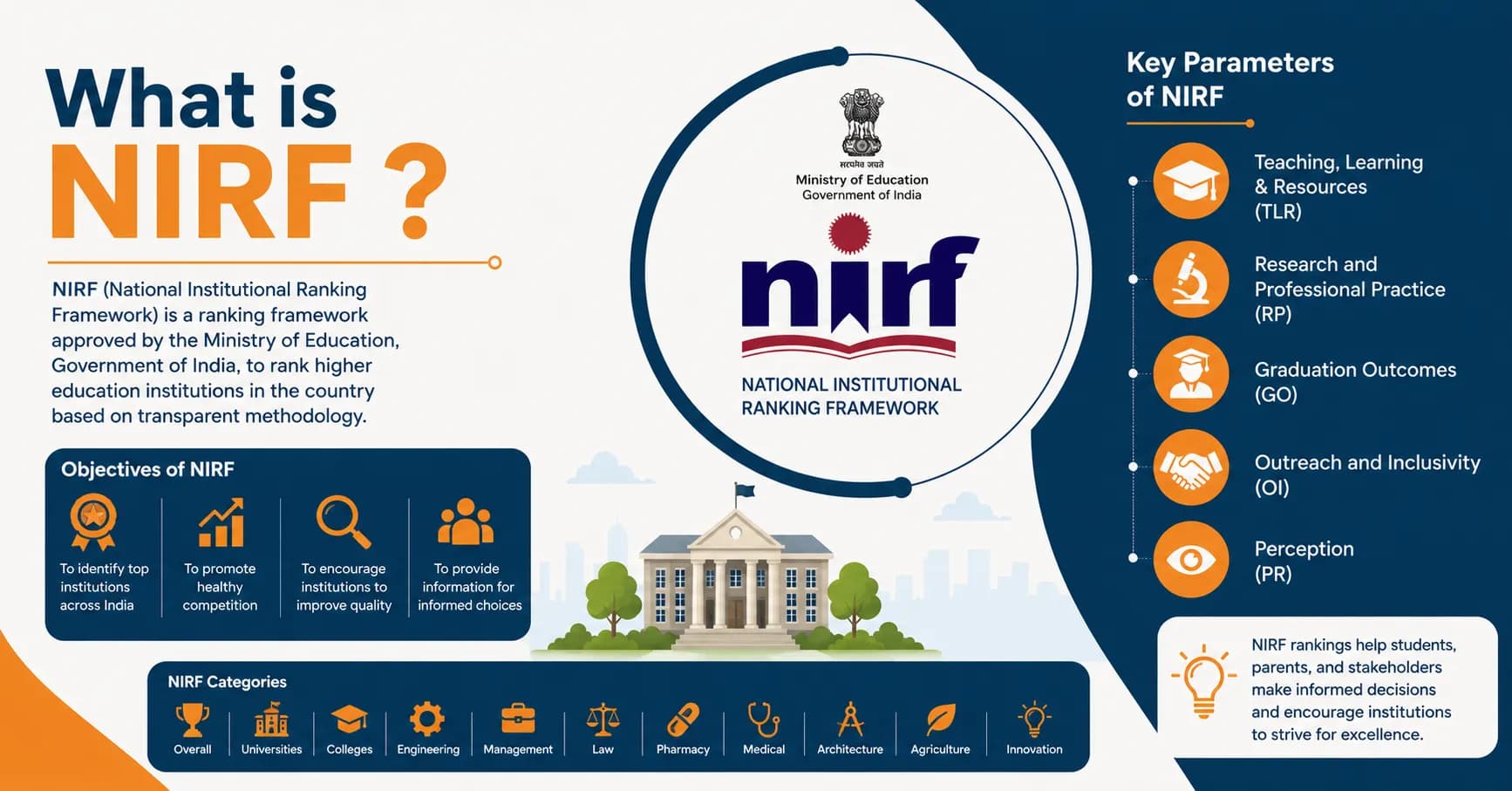

Selecting the right college can be difficult considering the fact that there are thousands of institutes of higher education in India. In order to facilitate comparison between colleges, the National Institutional Ranking Framework (NIRF) has been introduced as a standardised method of ranking colleges approved by the government. It is released yearly by the Ministry of Education in India. NIRF evaluates institutions based on teaching quality, research, placements, graduation outcomes, inclusivity, and overall reputation. Whether students are planning to pursue Engineering, Medical, Management, Law, or any other course, understanding NIRF rankings can help them make a well-informed admission decision. Here we covers the NIRF full form, ranking parameters, categories, methodology, and latest updates.
NIRF stands for National Institutional Ranking Framework. It is the ranking framework launched officially by the Ministry of Education (MoE), Government of India, to rank the higher educational institutions in India. NIRF was introduced on 29 September 2015. The reason behind introducing NIRF was to have a ranking system which is both transparent and based on factual numbers. The ranking system does not rank universities or colleges based on their popularity or past reputation.
Instead, it ranks them based on performance indicators such as teaching, research, placements, etc. Today, NIRF rankings have become a major tool for comparing educational institutions and are used widely by students, parents, educationalists, employers, and policymakers. It is unlike other ranking bodies in that the NIRF employs a methodology which is standardized and specific to Indian higher education institutions.
NIRF full form is National Institutional Ranking Framework. This ranking framework has been initiated by the Ministry of Education, which used to be known as the Ministry of Human Resource Development. Each year, the institutions submit their information on a voluntary basis, and the information is verified before publishing the rankings.
| Particular | Details |
|---|---|
| Full Form | National Institutional Ranking Framework |
| Introduced By | Ministry of Education (MoE), Government of India |
| Earlier Ministry Name | Ministry of Human Resource Development (MHRD) |
| Launch Date | 29 September 2015 |
| Ranking Frequency | Once Every Year |
| Official Website | nirfindia.org |
Before NIRF was launched, students depended largely upon advertisements, referrals from others, and private ranking agencies in selecting their college. The absence of a unified system of ranking by the government made it tough to compare the colleges. NIRF, therefore, was introduced by the Government of India with the aims of:
NIRF has seen major changes since its inception in 2015. Each year, the Ministry of Education has modified the framework by adding various categories and improving the assessment method in light of changes within higher education in India. At first, very few categories were included in the rankings. However, over time, various new disciplines have been added. These include law, medical, architecture, dental, agriculture, innovation, sustainability, and open universities.
| Year | Major Development |
|---|---|
| 2015 | NIRF framework launched by the Ministry of Human Resource Development |
| 2016 | First NIRF rankings released for Engineering, Universities, Management, and Pharmacy |
| 2017 | Overall and College categories introduced |
| 2018 | Participation from institutions increased significantly |
| 2019 | Medical, Law, Architecture, and Dental categories added |
| 2020 | Separate ranking introduced for Research Institutions |
| 2021–2024 | Methodology refined with greater emphasis on research quality and data verification |
| 2025 | Framework expanded to 17 categories, including Sustainability, Skill Universities, State Public Universities, and Open Universities |
Over the years, participation has grown from a few thousand applications to more than 7,600 institutions, making NIRF one of the largest higher education ranking systems in the world.
Ministry of Education (MoE), Government of India, issues NIRF rankings annually via its portal. While other ranking bodies usually lack a systematic method for ranking institutions, NIRF employs one where institutions provide information regarding academics, faculty, research, placements, diversity, finances, and infrastructure. The information is then cross-verified from government records before issuing the rankings. NIRF rankings issue yearly and involve institutions from different categories, making it easy for students to choose colleges based on the subject they wish to pursue.
NIRF applies a systematic approach in its evaluation process to maintain consistency and fairness in the ranking process. The entire process of evaluating each college or university involves several steps before giving a final rank.
Step 1: Institution Registration
Eligible colleges and universities register on the official NIRF portal and apply under one or more relevant categories.
Step 2: Data Submission
Institutions submit detailed information regarding:
Step 3: Data Verification
The submitted information is verified using multiple government databases and public records. Cross-verification helps ensure the authenticity of the data.
Step 4: Score Calculation
Each institution receives scores across five major parameters based on predefined weightages.
Step 5: Final Ranking
The weighted scores are combined to calculate the final score out of 100. Institutions are then ranked within their respective categories.
This transparent process helps maintain credibility and minimizes bias in the ranking system.
NIRF uses five key parameters for evaluating every participating institution. The parameters include different aspects that determine the performance of the institutions. Check below table for NIRF Ranking Parameters:
| Parameter | Weightage |
|---|---|
| Teaching, Learning & Resources (TLR) | 30% |
| Research & Professional Practice (RP) | 30% |
| Graduation Outcomes (GO) | 20% |
| Outreach & Inclusivity (OI) | 10% |
| Perception (PR) | 10% |
Teaching, Learning & Resources (TLR) is given the highest weightage of 30% in the ranking system of NIRF. The criteria for TLR include the quality of education, qualifications of teachers, student teacher ratio, infrastructure, labs, libraries, and financial resource. Good educational infrastructure and qualified teaching staff play an important role in scoring high TLR. Check below the factors considered under TLR:
Research and Professional Practice is the parameter that constitutes 30% of the total NIRF score. It is considered one of the two parameters that carry the highest weights. The parameter evaluates the research performance of colleges based on the number of publications, citations, patents, grants, consulting services, and industrial interactions. Well-performing colleges in research tend to score high in this parameter. Check below the parameters considered:
Colleges with strong research ecosystems and active innovation centres generally perform well under this parameter.
Graduation Outcomes (GO)
Graduation Outcomes (GO) is allotted 20% weightage in the NIRF ranking scheme. This metric assesses how well the students have performed post completion of their studies by analyzing their graduation rate, placements, salary, admissions to higher studies, etc. Those institutes which have good student performance and career prospects usually get good GO scores. Check below the factors included:
Outreach and Inclusivity (OI)
Outreach and Inclusivity (OI) has a weightage of 10% under the NIRF ranking system. It measures the extent to which institutions have a diverse and inclusive approach towards imparting education based on regional diversity, gender parity, education of the socioeconomically and socially underprivileged sections of the society, and specially abled students. Institutions promoting an inclusive learning environment score higher in this parameter. Check below the OI evaluation criteria:
Weightage of Perception (PR) is 10%. The perception score depends on how an institution is viewed by the employers, academics, scholars, and common masses. This score is derived from surveys and feedbacks, indicating the credibility and reputation of the institute among all the stakeholders in the higher education ecosystem. Perception conciders:
NIRF does not rank institutions based on one overall ranking. It ranks them according to different categories in order to make comparisons fair between colleges and universities within similar types. As of the latest edition, NIRF includes 17 ranking categories:
| Category | Institutions Covered |
|---|---|
| Overall | Best institutions across disciplines |
| University | Multi-disciplinary universities |
| College | Undergraduate and postgraduate colleges |
| Engineering | Engineering and Technology institutions |
| Management | Business schools and management institutes |
| Medical | Medical colleges |
| Pharmacy | Pharmacy institutions |
| Law | Law colleges and universities |
| Architecture & Planning | Architecture and planning institutes |
| Dental | Dental colleges |
| Research Institutions | Research-focused institutions |
| Agriculture & Allied Sectors | Agricultural institutions |
| Innovation | Innovation and entrepreneurship ecosystem |
| Open Universities | Distance and open learning universities |
| Skill Universities | Skill-based universities |
| State Public Universities | Government state universities |
| Sustainability | Institutions evaluated on sustainability practices |
Different subjects have varied teaching methods, research processes, job placement, and evaluation process. To make sure a fair comparison is done, the NIRF ranks institutions separately. This will help students to compare colleges in the same subject and make the right choice for their studies.
| Category | Why It Matters |
|---|---|
| Engineering | Compares engineering colleges with other engineering institutions for fair evaluation. |
| Medical | Ranks medical colleges based on healthcare education, research, and clinical training. |
| Management | Evaluates business schools using management-specific academic and placement parameters. |
| Law | Compares law universities based on legal education, research, and graduate outcomes. |
| University | Assesses multidisciplinary universities offering a wide range of academic programs. |
| College | Ranks standalone colleges based on teaching quality, student outcomes, and resources. |
| Pharmacy | Evaluates pharmacy institutions on education quality, research, and industry readiness. |
| Dental | Compares dental colleges using academic performance and clinical infrastructure. |
| Research Institutions | Focuses on institutions with strong research output, innovation, and publications. |
| Agriculture & Allied Sectors | Ranks agricultural institutions based on education, research, and extension activities. |
NIRF follows an open and scientific process for evaluation. All the participating institutions provide their details through the official portal of the NIRF. The provided information is authenticated before calculating the final scores. These include the following stages:
Step 1: Registration
Eligible institutions register on the official NIRF portal and select the categories in which they wish to participate.
Step 2: Data Submission
Institutions upload detailed information related to faculty, students, infrastructure, placements, research output, finances, patents, and outreach initiatives.
Step 3: Data Verification
The submitted information is cross-verified using official databases and other credible sources to ensure accuracy and consistency.
Step 4: Parameter-wise Scoring
Each institution receives a score under all five parameters based on the prescribed methodology and weightage.
Step 5: Final Score Calculation
The weighted scores are combined to generate a final score out of 100.
Step 6: Publication of Rankings
Institutions are ranked according to their final scores within their respective categories, and the official rankings are published on the NIRF website.
NIRF ranking process employs a systematic and well-defined approach for ranking higher education institutions in India. Every step in the ranking process is taken keeping in mind the issues of transparency and accuracy.
| Step | Process | Description |
|---|---|---|
| Step 1 | Institution Registration | Eligible colleges and universities register on the official NIRF portal and select the ranking categories in which they wish to participate. |
| Step 2 | Data Submission | Institutions submit detailed information related to faculty, students, placements, research, infrastructure, finances, outreach, and other required parameters. |
| Step 3 | Data Verification | The submitted information is verified using government databases, institutional records, and other reliable sources to ensure authenticity. |
| Step 4 | Parameter-wise Evaluation | Institutions are evaluated based on the five NIRF parameters: Teaching, Learning & Resources (TLR), Research & Professional Practice (RP), Graduation Outcomes (GO), Outreach & Inclusivity (OI), and Perception (PR). |
| Step 5 | Score Calculation | Each parameter is assigned a specific weightage, and the weighted scores are combined to calculate the institution's final NIRF score out of 100. |
| Step 6 | Ranking Preparation | Institutions are ranked according to their final scores within their respective categories, such as Engineering, Management, Medical, Law, and Overall. |
| Step 7 | Official Result Declaration | The Ministry of Education publishes the final NIRF rankings on the official NIRF website along with category-wise scores and reports. |
NIRF 2025 Rankings is the tenth version of India’s ranking system for universities. There were thousands of institutions that took part in the process, which makes it one of the largest evaluation processes of higher education institutions in the country.
Top 10 Overall NIRF 2025 Rankings
| Rank | Institution |
|---|---|
| 1 | IIT Madras |
| 2 | IISc Bengaluru |
| 3 | IIT Bombay |
| 4 | IIT Delhi |
| 5 | IIT Kanpur |
| 6 | IIT Kharagpur |
| 7 | AIIMS New Delhi |
| 8 | IIT Roorkee |
| 9 | IIT Guwahati |
| 10 | Jawaharlal Nehru University (JNU) |
Top 5 Engineering Colleges (NIRF 2025)
| Rank | Institute |
|---|---|
| 1 | IIT Madras |
| 2 | IIT Delhi |
| 3 | IIT Bombay |
| 4 | IIT Kanpur |
| 5 | IIT Kharagpur |
Top 5 Universities (NIRF 2025)
| Rank | University |
|---|---|
| 1 | IISc Bengaluru |
| 2 | Jawaharlal Nehru University |
| 3 | Manipal Academy of Higher Education |
| 4 | Jamia Millia Islamia |
| 5 | University of Delhi |
Top 5 Management Institutes (NIRF 2025)
| Rank | Institute |
|---|---|
| 1 | IIM Ahmedabad |
| 2 | IIM Bangalore |
| 3 | IIM Kozhikode |
| 4 | IIM Calcutta |
| 5 | XLRI Jamshedpur |
Top 5 Medical Colleges (NIRF 2025)
| Rank | Institute |
|---|---|
| 1 | AIIMS New Delhi |
| 2 | PGIMER Chandigarh |
| 3 | Christian Medical College, Vellore |
| 4 | JIPMER Puducherry |
| 5 | SGPGIMS Lucknow |
Selecting a college is not limited to simply reading through advertisements or placement claims. Rankings provided by NIRF give an objective means of comparing colleges based on various parameters. Check below the benefits of NIRF Ranking:
While NIRF ratings provide a great starting point, students must not depend completely on the aggregate rating. Each student will have his/her own priorities based on his/her academic program, budget, career objectives, and preferred location. Before selecting a college, compare the following factors along with the NIRF ranking.
| Factor | Why It Matters |
|---|---|
| Course Curriculum | Ensure the programme matches your career goals. |
| Placement Records | Check median salary, recruiters, and placement percentage. |
| Faculty | Experienced faculty improve learning quality. |
| Infrastructure | Modern labs, libraries, hostels, and campus facilities. |
| Fees | Compare tuition fees with expected return on investment. |
| Accreditation | Verify approvals like UGC, AICTE, and NAAC. |
| Student Reviews | Understand the actual campus experience. |
| Location | Consider internship and job opportunities nearby. |
National Institutional Ranking Framework (NIRF) is considered to be one of the most reliable ranking frameworks for the higher education institutions of India. With its clear methodology and evaluation process that is backed by the government, it allows students to compare different colleges according to their teaching, research, placements, and other important performance indicators. Nevertheless, even the most reliable ranking framework has its own set of disadvantages. Thus, although it provides very useful information, it should be used together with many other things before admitting into college. Check below the advantages and limitations of National Institutional Ranking Framework:
| Advantages of NIRF Rankings | Limitations of NIRF Rankings |
|---|---|
| Government-backed and highly credible ranking system. | Institutions submit much of their own data, which may affect accuracy despite verification. |
| Uses a transparent and standardized evaluation methodology. | Rankings may not fully reflect the actual student experience. |
| Helps students compare colleges across different disciplines. | Individual learning preferences and career goals are not considered. |
| Encourages institutions to improve teaching quality and research output. | Placement performance can vary significantly across departments within the same institution. |
| Considers placements, graduation outcomes, research, and inclusivity. | Overall rankings may not represent the strength of a specific course or specialization. |
| Promotes healthy competition among higher education institutions. | Private and government institutions operate under different conditions, making direct comparisons challenging. |
| Recognizes innovation, research, and academic excellence. | Recent improvements in an institution may only appear in the following year's rankings. |
| Serves as a reliable starting point for college selection. | Rankings should not be the sole basis for choosing a college or university. |
National Institutional Ranking Framework has expanded quickly since its establishment in 2015. Each year sees increased participation of universities in the ranking procedure.
| Year | Approximate Participation | Major Highlights |
|---|---|---|
| 2016 | Around 3,500 applications | First edition of rankings. |
| 2018 | More institutions joined | Improved methodology. |
| 2020 | Around 3,800 institutions | Dental category introduced. |
| 2022 | Participation continued to grow | Enhanced verification process. |
| 2025 | Over 14,000 applications from 7,600+ institutions | Expanded to 17 ranking categories. |
There are many students who get confused between NIRF and NAAC, but there is a difference between these two concepts. NIRF is the system of ranking which compares institutions through their performance. On the other hand, NAAC is the system of accreditation that rates the total quality of an institution. Both play an important role in choosing a college.
| Feature | NIRF | NAAC |
|---|---|---|
| Full Form | National Institutional Ranking Framework | National Assessment and Accreditation Council |
| Purpose | Ranks higher education institutions | Accredits and grades institutions based on quality |
| Managed By | Ministry of Education (MoE) | University Grants Commission (UGC) |
| Evaluation Type | Comparative ranking | Quality accreditation |
| Result Format | National rank | Grades such as A++, A+, A, B++ |
| Frequency | Annually | Generally every 5 years |
| Focus Areas | Teaching, research, placements, inclusivity, perception | Curriculum, governance, infrastructure, teaching-learning, research, student support |
| Best For | Comparing colleges for admission | Checking institutional quality and accreditation status |
Although both NIRF and QS World University Rankings evaluate higher education institutions, their scope and methodology are different. NIRF focuses on Indian institutions, whereas QS compares universities worldwide.
| Feature | NIRF | QS World University Rankings |
|---|---|---|
| Coverage | India | Global |
| Conducted By | Ministry of Education, Government of India | Quacquarelli Symonds (QS) |
| Institutions Ranked | Indian colleges and universities | Universities from around the world |
| Main Focus | Academic performance within India | Global academic and employer reputation |
| Parameters | Teaching, research, placements, inclusivity, perception | Academic reputation, employer reputation, citations, international faculty and students |
| Primary Users | Indian students | Students seeking international education |
Although it is popular, there are a number of misunderstandings regarding NIRF rankings. Getting to know about these will assist students in making good admissions choices.
| Myth | Reality |
|---|---|
| A higher NIRF rank guarantees the best placement. | Placements vary by course, branch, and market conditions. |
| Only IITs and IIMs perform well in NIRF. | Many universities and private institutions also secure top positions. |
| Lower-ranked colleges are not good. | Several institutions excel in specific courses despite lower overall rankings. |
| NIRF considers only placements. | It evaluates teaching, research, graduation outcomes, inclusivity, and perception. |
| NIRF should be the only factor while choosing a college. | Students should also compare fees, faculty, infrastructure, accreditation, and campus life. |
Yes, NIRF can be considered as one of the most credible rankings of colleges in India, as it employs a completely transparent mechanism that was developed by the Ministry of Education. Nevertheless, while selecting colleges for admission, students must keep certain things in mind apart from the ranking of the college, including the quality of courses and other aspects of education.
Students can easily access the latest NIRF rankings through the official website. The portal allows users to explore rankings across different years and categories. Check below the steps to check NIRF rankings:
NIRF 2026 rankings have not been released officially till now. However, considering the previous years' patterns of releases of the NIRF ranking, the Ministry of Education will release these rankings during July to September 2026. It is advisable for students to regularly visit the official NIRF website for further updates.
National Institutional Ranking Framework (NIRF) is an authentic framework for ranking colleges with respect to education, research, placements, inclusiveness, and performance of institutions. Though NIRF ranks colleges and universities and gives information regarding them, it should not be taken into consideration alone while choosing the institution; other aspects such as courses, fee, certification, faculty, facilities, and student feedback should also be kept in mind.
© 2026 Nuvora Education Private Limited. All rights reserved.