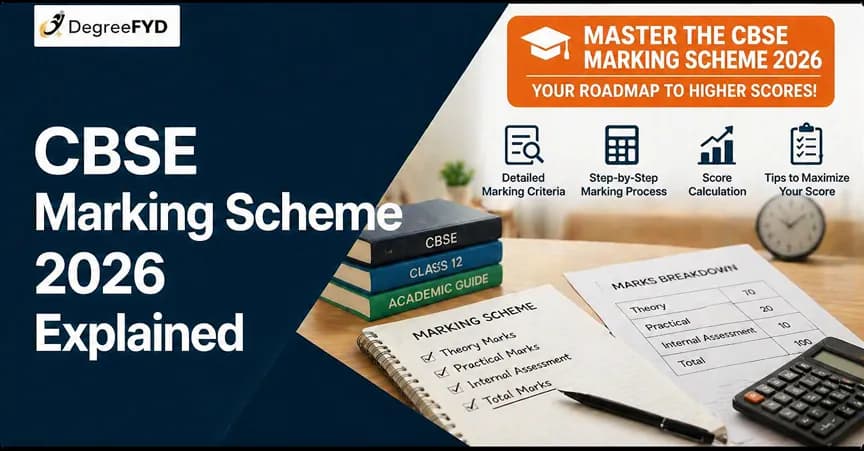

Every year many candidates of class 12 in India appear for the board exams, learn formulas, solve past year papers and repeat answers. For most students, however, it was always the same experience. But a big change happened in the way exams were done that many didn't seem to notice in 2026. Earlier the teachers used to evaluate the answer sheets manually. But starting in the year 2026, CBSE launched a new system called OSM. Under the new scheme, the answer sheets are marked on a computer screen instead of manually. In the process of evaluation system of CBSE, it can be considered as revolutionary change and not a minor change.
CBSE introduced changes in the evaluation system to make the marking process faster, more accurate, and fair for students. The old method of checking answer sheets manually had many challenges, such as calculation mistakes, examiner stress, and risks during the transport of copies. These issues sometimes affected student marks and delayed results. To improve this, CBSE moved to a digital system called On-Screen Marking (OSM), where answer sheets are checked on computers. This step helps reduce errors, improves monitoring, and provides a more reliable and transparent evaluation process for CBSE Class 12 students.
On-Screen Marking (OSM) system follows a clear and organised process from the moment a student submits the answer sheet to the final marking stage. This digital method is designed to reduce errors, improve speed, and maintain fairness. Understanding each step helps students know how their copies are handled and why writing clearly still matters.
CBSE Marking Scheme 2026 keeps the same rules for marking, but the way marks are recorded and calculated has changed with the On-Screen Marking (OSM) system. Below is a structured explanation to help you understand it clearly.
1. Marking Scheme Remains the Same
| Aspect | Old System (Manual) | New System (OSM) |
|---|---|---|
| Marking Scheme | Same CBSE guidelines | Same CBSE guidelines |
| Mark Entry | Written by hand | Entered digitally |
| Total Calculation | Done manually | Automatic calculation |
| Error Chances | High (totalling mistakes) | Almost zero |
| Transparency | Limited | Better tracking |
2. How Marks Are Recorded in OSM
| Step | Process |
|---|---|
| Step 1 | Examiner checks each answer |
| Step 2 | Marks are entered question-wise in system |
| Step 3 | System keeps a running total |
| Step 4 | Final marks are auto-calculated |
3. Elimination of Totalling Errors
| Problem in Old System | Solution in OSM |
|---|---|
| Wrong addition of marks | Automatic calculation |
| Missed section totals | System tracks all entries |
| Human calculation mistakes | Fully digital process |
4. Final Marks Calculation Formula
| Component | Description | Evaluation Method |
|---|---|---|
| Theory Exam | Written board exam | Checked through OSM |
| Practical/Internal | Lab work, projects, internal tests | Assessed by schools |
5. Overall Result Formation
| Stage | Explanation |
|---|---|
| Subject-wise Marks | Calculated by combining theory + practical |
| Final Result | Based on marks in all subjects |
| Result Declaration | Done by CBSE after evaluation |
The introduction of the On-Screen Marking (OSM) system has made the evaluation process faster, more efficient, and more accurate. It not only reduces the time taken to declare results but also improves the rechecking process by removing common errors like wrong total calculation. This helps students get their CBSE results earlier and with greater confidence.
1. Result Timeline Comparison
| Process Stage | Old System (Manual) | New System (OSM) |
|---|---|---|
| Collection & Transport | Time-consuming (physical movement) | Not required (digital upload) |
| Evaluation | Slower (manual checking) | Faster (on-screen checking) |
| Marks Compilation | Manual record handling | Automatic system recording |
| Total Time Taken | Around 12 days | Around 9 days or less |
2. Benefits of Faster Results
| Benefit | Explanation |
|---|---|
| Early College Applications | Students can apply sooner |
| Timely Counselling | No delay in admission process |
| Better Planning | More time for academic decisions |
3. Rechecking: Old vs New System
| Aspect | Old System | OSM System |
|---|---|---|
| Totalling Errors | Common | Eliminated |
| Rechecking Purpose | Verify totals + marking | Mostly for marking review |
| Need for Requests | Higher | Reduced |
| Accuracy Level | Moderate | High |
4. Re-evaluation Process
The introduction of On-Screen Marking (OSM) in CBSE Class 12 is not just a technical change. It shows a bigger shift in how India’s education system is becoming more modern, transparent, and reliable. With lakhs of students appearing for board exams every year, even a small improvement in evaluation can have a large impact.
1. A Major National-Level Reform
| Factor | Details |
|---|---|
| Students Affected | Around 46 lakh globally |
| Level of Change | One of the largest exam reforms |
| Importance | High impact on fairness and accuracy |
2. Alignment with Global Standards
| Country/Region | Practice |
|---|---|
| United Kingdom | Uses on-screen marking |
| Australia | Digital evaluation system |
| Other Countries | Following similar methods |
3. Benefits Observed Globally
| Improvement Area | Impact |
|---|---|
| Marking Consistency | More uniform evaluation |
| Error Reduction | Fewer calculation mistakes |
| Student Satisfaction | Better trust in results |
4. Data-Driven Evaluation System
| Feature | Explanation |
|---|---|
| Marking Data | Collected across subjects and centres |
| Performance Tracking | Helps identify patterns |
| Improvement Scope | Better training and guidelines |
5. Future Expansion Plans
| Current Status | Future Possibility |
|---|---|
| Applied to Class 12 | May extend to Class 10 |
| Timeline | Not officially confirmed |
On-Screen Marking (OSM) system changes the way answer sheets are checked, so students need to focus more on clear writing and proper presentation. Since examiners read scanned copies on a screen, small mistakes in writing style or structure can affect readability. The following tips explain how to write your exam in a way that suits this new system.
CBSE Marking Scheme 2026 brings a major shift with the introduction of digital evaluation through OSM. While the syllabus and marking rules remain the same, the focus is now on clear and structured answer presentation. This system improves accuracy, reduces errors, and speeds up results. It also makes evaluation more transparent and reliable for both students and teachers. Overall, OSM is a strong step toward a modern and fair examination system that students can trust.
© 2026 Nuvora Education Private Limited. All rights reserved.