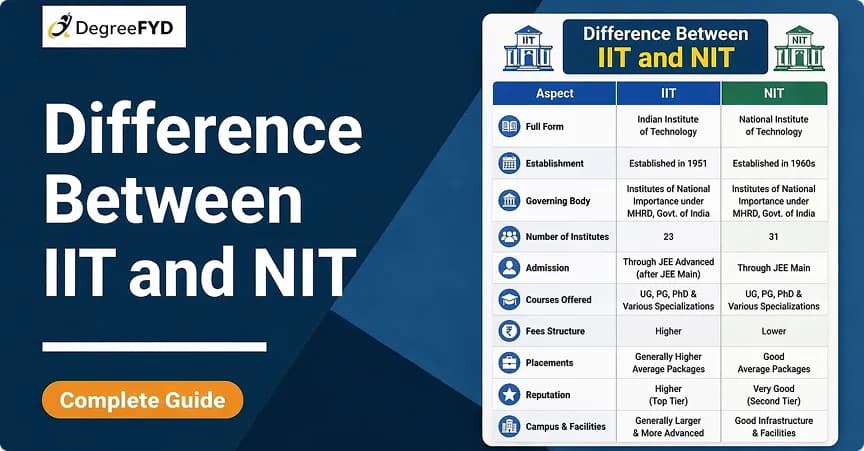

Difference Between IIT and NIT is a common question among engineering students in India. Both are top government colleges that offer good education and job prospects, but they are not the same. A lot of students are having trouble deciding between them. This blog will help you understand the main differences in a simple way, such as the application process, the level of difficulty, the fees, the placements, and which option might be better for you. This will help you choose your future with confidence and clarity.
Many students often ask what is IIT and also want to know the full form of IIT. The difference between IIT and NIT starts with understanding IIT clearly. IIT full form is Indian Institute of Technology. These are some of the top autonomous public engineering institutes set up by the Government of India. IITs were established under the Institutes of Technology Act, 1961 and are recognised as Institutes of National Importance. IITs are known for strong academics, research work, and high placement opportunities. IIT admission mainly happens through the JEE Advanced exam, which is one of the toughest exams in India. The first IIT was established in Kharagpur in 1951, and today there are 23 IITs across the country. Check the table below for highlights of IIT:
| Feature | Details |
|---|---|
| Full Form | Indian Institute of Technology |
| Established Under | Institutes of Technology Act, 1961 |
| Total Institutes | 23 IITs |
| First IIT | IIT Kharagpur (1951) |
| Admission Process | JEE Advanced |
| Conducting Body | Government of India |
| Status | Institute of National Importance |
| Focus Area | Engineering, Technology, Research |
| Top IITs | IIT Bombay, IIT Delhi, IIT Madras, IIT Kanpur, IIT Kharagpur |
Many students ask what is NIT when learning about the difference between IIT and NIT, and some also want to know what is NIT full form. NIT stands for National Institute of Technology. These are government-funded public engineering colleges in India and are recognised as Institutions of National Importance under the National Institutes of Technology Act, 2007. NITs were established to spread quality technical education across different states of India. They offer good academic programs, facilities, and placement opportunities. NIT admission is mainly done through the JEE Main exam. At present, there are 31 NITs across the country, making them one of the top choices for engineering aspirants. Check the table below for NIT highlights:
| Feature | Details |
|---|---|
| Full Form | National Institute of Technology |
| Established Under | NIT Act, 2007 |
| Total Institutes | 31 NITs |
| Admission Process | JEE Main |
| Conducting Body | Government of India |
| Status | Institute of National Importance |
| Purpose | Regional technical education development |
| Focus Area | Engineering and Technology |
| Top NITs | NIT Trichy, NIT Surathkal, NIT Warangal, NIT Calicut |
IIT & NIT difference between helps students understand which option suits them better. Both offer good education and strong career scope, but they are not the same. They differ in exams, fees, placements, and overall exposure. Check the table below for a clear comparison.
| Criteria | IIT | NIT |
|---|---|---|
| Full Form | Indian Institute of Technology | National Institute of Technology |
| Year of Establishment | 1951 (First IIT Kharagpur) | 1960s (earlier RECs, became NITs in 2007) |
| Total Number of Institutes | 23 | 31 |
| Admission Exam | JEE Advanced | JEE Main |
| Average Annual Fees | INR 2 to 5 Lakhs | INR 1 to 2 Lakhs |
| Average Placement Package | INR 20 to 30 LPA (top IITs higher) | INR 10 to 15 LPA (top NITs higher) |
| Global Reputation | Very High | High (mainly in India) |
| Focus | Research + Academics | Academics + Industry |
The difference between IIT & NIT in fees is simple. IITs have a more fixed fee, around INR 2–2.5 lakhs per year, with a total cost of about INR 8–10 lakhs. NITs have lower tuition, about INR 62,500 per semester, but extra charges like hostel and other fees can change by college. So, IITs cost slightly more, while NITs are more affordable but vary from one institute to another. IITs cost a bit more but have a fixed structure. NITs cost less, but total fees can change based on college and facilities.
IIT BTech Fee
| IIT Name | Semester Fee (INR) | Total Course Fee (INR) |
|---|---|---|
| IIT Dhanbad | 1,00,000 | 8,00,000 |
| IIT Delhi | 1,07,800 | 8,50,000 |
| IIT Guwahati | 1,11,750 | 8,50,000 |
| IIT Bombay | 1,19,750 | 9,50,000 |
| IIT Bhubaneswar | 1,43,000 | 10,00,000 |
| IIT Bhilai | 1,08,000 | 8,00,000 |
| IIT Dharwad | 1,22,786 | 9,70,000 |
| IIT Gandhinagar | 1,28,500 | 10,00,000 |
| IIT Kharagpur | 1,48,700 | 10,00,000 |
| IIT Kanpur | 1,12,142 | 8,50,000 |
| IIT Indore | 1,28,650 | 10,00,000 |
| IIT Jodhpur | 1,18,275 | 9,00,00 |
NIT BTech Fee
| NIT Name | Tuition Fee (per semester) | Other Fees | Hostel Fee |
|---|---|---|---|
| NIT Andhra Pradesh | 62,500 | 27,500 | 38,000 |
| NIT Uttarakhand | 62,500 | 33,000 | 20,291 |
| NIT Tiruchirappalli | 62,500 | 24,000 | 11,100 |
| NIT Silchar | 48,500 | NA | 25,500 |
| NIT Manipur | 77,000 | NA | 28,800 |
| NIT Kurukshetra | 62,500 | NA | 93,500 |
| NIT Rourkela | 62,500 | 10,000 | 17,500 |
| NIT Mizoram | 69,350 | NA | 26,400 |
| NIT Warangal | 62,500 | NA | 39,000 |
IIT admission process has two stages and needs top performance in both exams. Students must first clear JEE Main and then qualify for JEE Advanced. Only the top rankers move to the next stage, which makes IIT admission very competitive and requires strong preparation and clear concepts.
NIT admission process is simpler and depends only on JEE Main score. There is no second exam like IIT. Students need a good rank in JEE Main and then take part in counselling to get admission in their preferred NIT and course.
© 2026 Nuvora Education Private Limited. All rights reserved.