

Content Creator
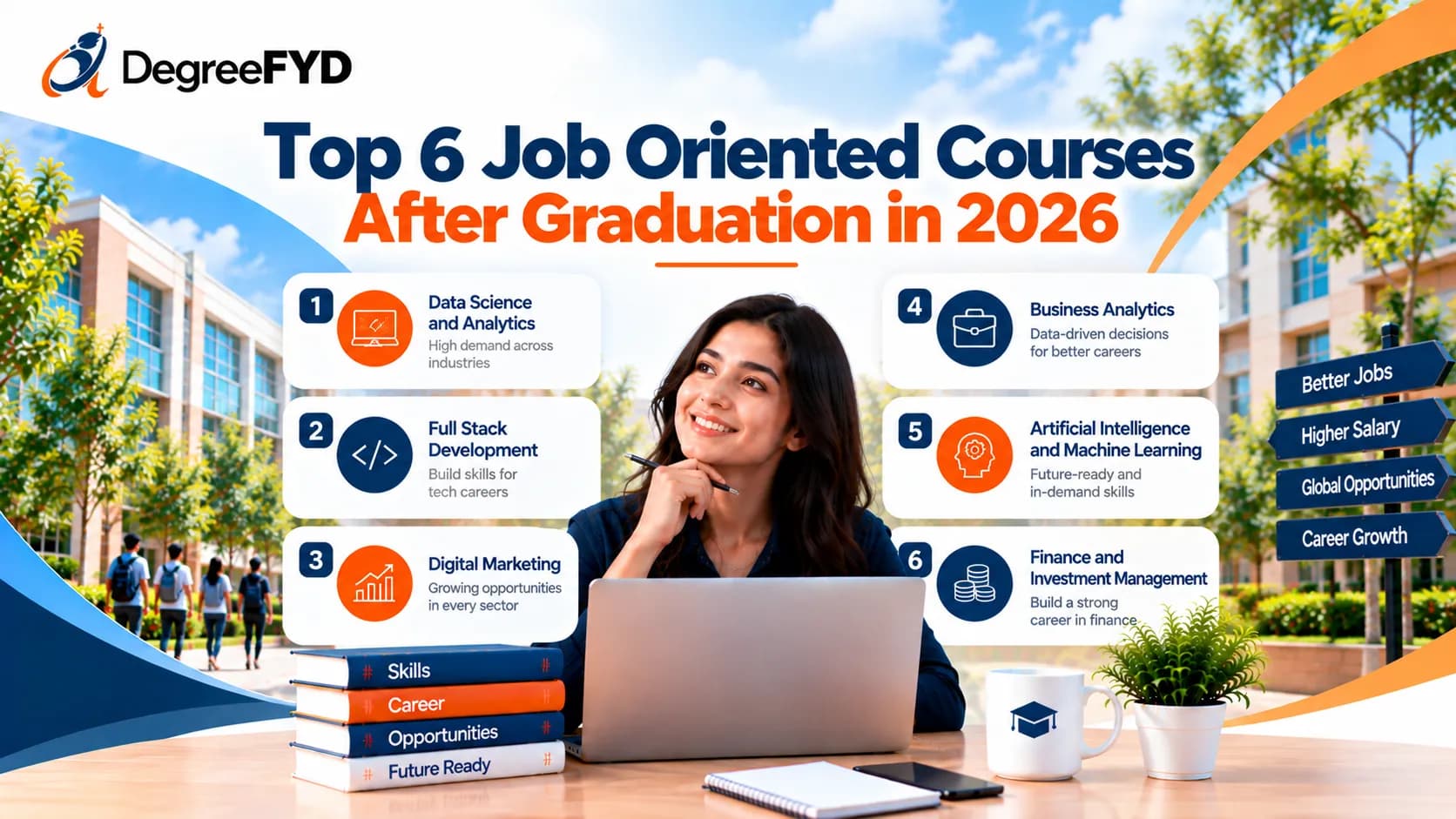
A graduation degree will provide you a job, but if you are having the right skills. It will help you to move forward. The trend of hiring employees by employers is becoming increasingly inclined towards practical and digital skills due to AI and technological changes taking place in job roles i n 2026. According to the India Skills Report 2026, India’s total graduate employability stands at 56.35%, an increase from 54.81% in 2025. T he report has identified some of the most sought-after skills such as AI, Data Analytics, Cloud Computing, and Cybersecurity. It becomes very important while choosing a course after graduation as it can help you imbibe specialized skills along with your degree. This article discusses 6 job-oriented courses after graduation in 2026. The discussion involves eligibility criteria, course fees, career opportunities, salary range for freshers and suitability of each course.
After completing graduation, you should select the right course, which will enable you to develop special skills and increase your job prospects. A job-oriented course is aimed at developing practical knowledge and career-related skills. Job-oriented courses include skills needed to make the individual fit for the role in management, technology, finance, digital marketing, and data analysis. You may opt for different types of courses like certification, postgraduation, or skill-based professional courses.
| Course | Typical Duration | Open To | Indicative Fresher Salary | Best For |
|---|---|---|---|---|
| Data Science & AI/ML | 6–24 months | Graduates; maths, statistics or coding background helps | ₹4–8 LPA | Graduates with strong analytical and coding skills |
| Cybersecurity | 3–12 months for certifications; longer for degree programmes | Graduates; basic IT knowledge helps | ₹3–7 LPA | Students interested in security, networks and risk |
| Cloud Computing & DevOps | 3–12 months for certification-based courses | Graduates; IT or technical background helps | ₹4–8 LPA | Tech graduates interested in cloud and IT infrastructure |
| Digital Marketing | 3–6 months | Graduates from any stream | ₹2.5–5 LPA | Students interested in marketing, content and digital platforms |
| CFA / ACCA / US CMA | 1–4 years, depending on qualification and pace | CFA: graduates from any stream; ACCA/US CMA: suitable for commerce and finance backgrounds | ₹4–8 LPA | Graduates who want careers in finance, accounting or investment |
| MBA / PGDM | 2 years | Graduates; eligibility varies by institute | ₹4–10+ LPA, varies by institute | Graduates who want management, business or specialised roles |
Note: Salary ranges are indicative market ranges, not guaranteed salaries. The actual package depends on the institute, role, location, skills, internships, projects and employer.
Data Science and AI/ML happen to be one of the most relevant career-oriented disciplines for those students who wish to join the workforce related to data, automation and artificial intelligence. This discipline provides a wide range of options in terms of education, ranging from short courses to MCA and MSc degrees.
| Factor | Details |
|---|---|
| What it covers | Data analysis, machine learning, artificial intelligence, predictive models and generative AI tools |
| Why it is in demand | AI and data analytics are among the key in-demand skill areas in the India Skills Report 2026 |
| Course options | PG diploma or certificate courses of around 6–13 months; MCA or MSc programmes usually take 2 years; self-learning is also an option |
| Eligibility | Most courses accept graduates from different streams. Basic statistics and probability can help |
| Popular job roles | Data Analyst, Junior Data Scientist, ML Engineer Trainee and Business Intelligence Analyst |
| Fresher salary | Around ₹5–8 LPA as an indicative range; strong skills and projects can lead to higher packages |
| Best for | Graduates who are comfortable with numbers, analysis, coding and regular practice |
| For non-tech graduates | Start with Excel, SQL, Power BI or Tableau, then move towards machine learning |
| Important point | Practical projects matter along with certificates. A portfolio can help demonstrate your skills to employers |
Cybersecurity is one of the best career options for those wishing to have careers in system security and network protection. One can pursue a career in this area by taking certifications or completing an entire degree programme in the subject. It is easy to learn with networking and Linux basics.
| Factor | Details |
|---|---|
| What it covers | Network security, system protection, threat detection, ethical hacking and data security |
| Why it is in demand | Cybersecurity is among the key skill areas highlighted in the India Skills Report 2026, along with AI, data and cloud |
| Course options | Security+ for fundamentals, CEH for ethical hacking, cloud security certifications, or BCA/MCA with a cybersecurity specialisation |
| Eligibility | Most certification courses accept graduates from any stream. Basic networking and Linux knowledge helps |
| Popular job roles | SOC Analyst, Network Security Analyst, Cybersecurity Analyst and Junior Penetration Tester |
| Fresher salary | Around ₹3.5–8 LPA as an indicative range, based on skills, certification, location and employer |
| Best for | Graduates who enjoy problem-solving, investigation and technical work |
| Useful skills | Networking, Linux, security tools, ethical hacking, threat analysis and basic scripting |
| Practical experience | Labs, CTFs and security projects can help you build practical skills alongside a certification |
| Important point | Start with cybersecurity fundamentals before paying for advanced certifications. Hands-on skills matter along with certificates |
Cloud computing and DevOps mainly deal with the use of software and other tools involved in application development and deployment on platforms like AWS, Azure, and Google Cloud. The study will be ideal for individuals who love anything about technology and problem solving. One can start the studies by getting certified or joining a DevOps program before working on practical projects.
| Factor | Details |
|---|---|
| What it covers | Cloud platforms, deployment, Linux, Git, Docker, Kubernetes, CI/CD and infrastructure as code |
| Why it is in demand | Cloud computing is among the key in-demand skills highlighted in the India Skills Report 2026 |
| Course options | AWS Cloud Practitioner followed by an Associate certification, Azure or Google Cloud certifications, or a DevOps course |
| Certification cost | AWS Cloud Practitioner: USD 100; Associate-level exams: USD 150. Indian costs vary with exchange rates and taxes |
| Eligibility | Any graduate can start. IT knowledge can make the learning process easier |
| Popular job roles | Cloud Support Associate, Cloud Engineer, DevOps Engineer Trainee and Junior Cloud Administrator |
| Fresher salary | Around ₹4–8 LPA as an indicative range, depending on skills, certification, location and employer |
| Best for | BCA, BSc IT/CS and engineering graduates who enjoy systems, cloud platforms and troubleshooting |
| Useful skills | Linux, Git, AWS/Azure/GCP, Docker, Kubernetes, Terraform and CI/CD |
| Practical experience | Build and deploy a website or application, create a CI/CD pipeline or work on a cloud-based project |
| Important point | A certification alone may not be enough for a fresher role. Practical projects can help show your ability to use cloud and DevOps tools |
Digital Marketing is a term used for all the online techniques used by companies to connect with their customers online for create leads, and increase sales. This may include SEO, paid advertising, social media, content, email marketing, and analytics. Anyone from any stream can join this domain through short courses or certifications.
| Factor | Details |
|---|---|
| What it covers | SEO, paid ads, social media, content marketing, email marketing and analytics |
| Why it is in demand | Businesses across sectors need digital channels to reach customers and promote their products or services |
| Course options | Certificate or diploma courses of around 3–6 months, Google Ads and Google Analytics certifications, or BBA/MBA with a Digital Marketing specialisation |
| Eligibility | Graduates from any stream. Basic computer and internet skills are enough to start |
| Popular job roles | Digital Marketing Executive, SEO Executive, Social Media Executive, PPC/Performance Marketing Trainee and Content Marketer |
| Fresher salary | Around ₹2.5–6 LPA as an indicative range, depending on skills, role, location and employer |
| Best for | Graduates with strong communication, creative and analytical skills |
| Useful skills | SEO, Google Ads, social media, content writing, analytics and campaign management |
| Practical experience | Live campaigns, internships, personal websites and sample marketing projects can help build a portfolio |
| Important point | Specialisation can improve your career path. You can focus on SEO, performance marketing, content or marketing analytics based on your interests |
finance certifications will give you an additional specialty to your graduate degree without having to take up another full time degree. The certifications in CFA, ACCA and US CMA cater to specific branches of finance; hence you need to decide which one to pursue based on your area of specialization.
| Qualification | Main Focus | Eligibility & Typical Duration |
|---|---|---|
| CFA | Investment analysis, financial markets and portfolio management | A bachelor’s degree or equivalent is one route. Undergraduate students can also register under CFA Institute’s education requirements. The programme has 3 exam levels and typically takes around 3–4 years to complete. |
| ACCA | Accounting, financial reporting, audit and advisory | Graduates may receive exemptions based on their previous qualifications. The total time varies by exemptions and exam pace; many students complete it in around 2–4 years. |
| US CMA | Management accounting, FP&A, financial analysis and corporate finance | A bachelor’s degree is required for certification, along with two years of relevant professional experience. The two exam parts can often be completed in around 12–18 months. |
An MBA or PGDM can help to enhance your knowledge of management and business and create opportunities for yourself in sectors like finance, marketing, human resources, operations, and business analytics. It is very important to choose the best programme based on factors like institute, syllabus, cost of education, and placements.
| Factor | Details |
|---|---|
| What it covers | Management, finance, marketing, HR, operations, business analytics and other specialisations |
| Duration | Usually 2 years for a full-time MBA or PGDM |
| Eligibility | A bachelor's degree is generally required. CAT's IIM eligibility specifies at least 50% marks or equivalent CGPA, with 45% for SC, ST and PwD candidates. |
| Entrance options | CAT, XAT, CMAT, SNAP, NMAT and institute-specific exams, depending on the college |
| CAT 2026 | CAT 2026 registration was scheduled for August 3–September 15, with the exam scheduled for November 29, 2026 |
| Work experience | Not mandatory for CAT eligibility. Individual institutes may give weight to work experience during selection |
| Fees | Vary widely across institutes, so compare the complete programme fee rather than using one general figure |
| Career options | Management trainee, business analyst, marketing executive, HR executive, finance roles, operations roles and consulting-related positions |
| Best for | Graduates who want management, business, consulting, marketing or specialised corporate roles |
| Online option | UGC-entitled online MBA programmes are another route for graduates who need a flexible study format |
| Important point | Compare the official placement report, median salary, placement percentage, batch size and total fee instead of focusing only on the highest package |
Your educational background will helps you to choose the right job oriented program, although it doesn’t necessarily confine you to one choice. It will be relatively easier for a technical graduate to get into cloud computing, cybersecurity, or artificial intelligence; whereas a commerce or management graduate may opt for finance or marketing. Graduates of any stream can begin an entirely new career with programs starting from basics.
| Your Degree | Strong Options |
|---|---|
| BCA / BSc IT, CS / BTech | Cloud Computing & DevOps, Cybersecurity, Data Science & AI/ML |
| BSc Maths / Statistics / Physics | Data Science & AI/ML, Data Analytics, Finance Certifications |
| BCom / BBA / Economics | Finance Certifications, MBA/PGDM, Digital Marketing, Data Analytics |
| BA / Mass Communication | Digital Marketing, MBA/PGDM, Data Analytics |
| Any Degree – Career Switch | Digital Marketing, Data Analytics, Cybersecurity Foundations, depending on your interest and basic skills |
Select the correct course should take into account your targeted job position, your present abilities, finances, and time. You should not select a course just because it is popular or will earn you a lot of money. You should take into consideration the skills required by employers, total cost of the course, and the time you have to devote to learning. Above all, choose a course that will provide you with practical projects for interview purposes.
A skill-based course will provide you practical knowledge on top of your graduation degree. Data Science & AI/ML, Cybersecurity, Cloud Computing & DevOps, Digital Marketing, Finance Certification & MBA/PGDM all open up diverse career opportunities. The stream of your graduation, budget, time and targeted job must be the deciding factors while selecting the right course. Prior to signing up for a course, ensure that you compare the syllabus, overall cost, eligibility criteria and hands-on experience of the course. Most importantly, gain some project or internship experience through the course.
© 2026 Nuvora Education Private Limited. All rights reserved.