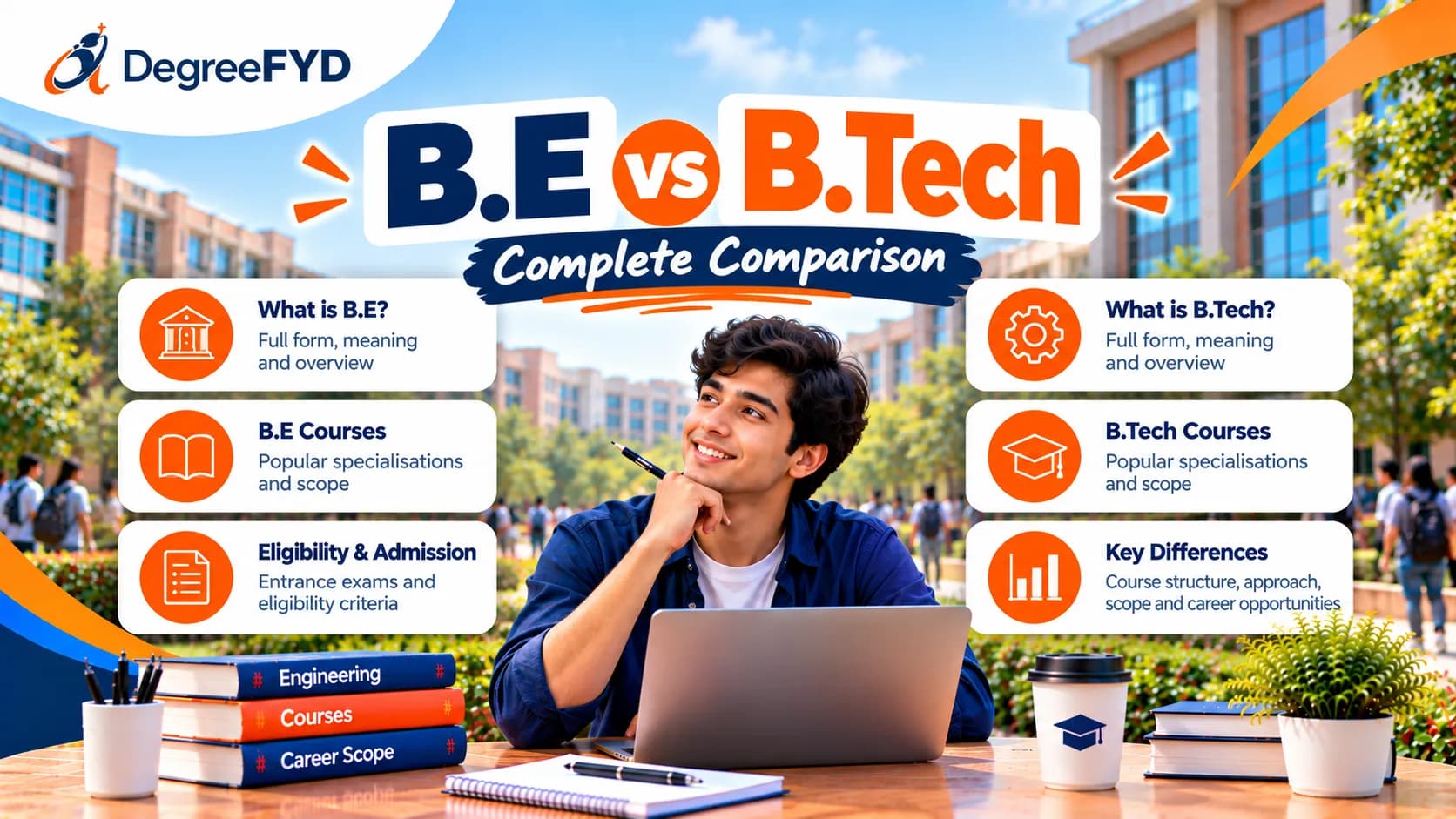

B.E and B.Tech are the most commonly chosen engineering programs after passing the Class 12 examinations in PCM subjects. Duration of both the programs is the same, and both provide equally good career opportunities and future education options. The main difference depends on the degree a college offers and how it teaches the course. Students can make comparison between the two based on many aspects including structure, best colleges, cost, salary, and career prospects.
B.E. stands for Bachelor of Engineering. BE is an undergraduate degree program that lasts for four years, with eight semesters. Specialisations offered in this field include Civil Engineering, Mechanical Engineering, Electrical Engineering, and Electronics & Computer Science Engineering. This program covers subjects related to engineering, mathematics, science, and practical aspects of the subject. Though some people view B.E. to be more theoretical, yet the methodology of teaching depends upon the college curriculum.
B.Tech means Bachelor of Technology. It is an undergraduate program that takes four years and is made up of eight semesters. There are specializations in various fields such as Computer Science, Mechanical, Civil, and Electrical and Electronics Engineering. This includes engineering concepts, practicals, labs, projects, and technical knowledge. However, B.Tech is believed to have a greater practical approach, but it depends on the college and their curriculum.
There are several similarities between BE and BTech in relation to the length of course, eligibility criteria, admission test and career prospects. The difference lies in the title of the degree given by the college, and sometimes in the course curriculum. This is shown in the following table.
| Comparison Factor | BE (Bachelor of Engineering) | BTech (Bachelor of Technology) |
| Full form | Bachelor of Engineering | Bachelor of Technology |
| Course duration | 4 years (8 semesters) | 4 years (8 semesters) |
| Course level | Undergraduate degree | Undergraduate degree |
| Learning approach | Covers engineering principles and practical applications | Covers engineering principles, technical skills and practical applications |
| Colleges that offer it | Anna University, VTU, BITS Pilani and others | IITs, NITs, IIITs and many private universities |
| Eligibility | Class 12 with Physics, Chemistry and Mathematics (PCM), subject to college rules | Class 12 with Physics, Chemistry and Mathematics (PCM), subject to college rules |
| Entrance exams | JEE Main, state-level entrance exams, BITSAT and university exams | JEE Main, JEE Advanced for IIT admission, state-level entrance exams and university exams |
| Recognition in India | Recognised as an engineering degree, subject to applicable approval and accreditation requirements | Recognised as an engineering degree, subject to applicable approval and accreditation requirements |
| Eligible for GATE | Yes, subject to exam eligibility rules | Yes, subject to exam eligibility rules |
| Higher study options | ME, MTech, MS and MBA | ME, MTech, MS and MBA |
| Government and PSU jobs | Eligible where the recruitment rules accept BE | Eligible where the recruitment rules accept BTech |
| Salary prospects | Depends on the college, specialisation, skills and employer | Depends on the college, specialisation, skills and employer |
The difference in the names BE and BTech has been made due to Indian university naming culture. The two programs are of the same educational level, and different colleges give different names to the same program.
How Did the Two Degree Names Start?
There is a general perception among the students that BE lays more emphasis on theory, whereas BTech emphasizes practical aspects. However, both courses involve studies of engineering principles, laboratory practices, and projects. This depends largely on the university and college rather than being dependent on the title of the course itself. The following table clarifies certain misconceptions regarding BE and BTech.
| Comparison Factor | Common Belief | What Students Should Know |
| Curriculum | BE focuses on theory, while BTech focuses on practical skills. | Both degrees cover theoretical concepts and practical applications. The balance depends on the college. |
| Syllabus updates | BTech has a more updated syllabus. | The university decides when and how to update the syllabus. The degree name does not determine how often changes take place. |
| Internships and industrial training | Internships are compulsory in BTech but optional in BE. | Requirements vary by college. Students should check the course structure to understand the internship and training requirements. |
| Core subjects | BE and BTech have different subjects. | Both cover subjects such as Mathematics, Physics, programming and engineering fundamentals, along with subjects related to the chosen specialisation. |
| Laboratory work and projects | BTech has more lab work and projects. | The number of lab sessions, projects and practical credits depends on the university's curriculum. |
Criteria for BE & BTech are generally similar. Candidates have to complete Class 12 with desired subjects along with the marks needed in the respective subject from the institute they opt for. Some institutes require candidates to clear the entrance test.
| Eligibility Factor | Typical Requirement |
| Educational qualification | Class 12 (10+2) from a recognised board |
| Required subjects | Physics and Mathematics, along with Chemistry or another accepted subject, as per the institute's rules |
| Minimum marks | Usually 45%–50% in the required subjects at many colleges. Some institutes follow different criteria. |
| Entrance exam | JEE Main, JEE Advanced, state-level entrance exams, BITSAT or university-level tests, depending on the college |
| Age limit | Depends on the entrance exam and institution. JEE Main has no upper age limit, but other eligibility conditions apply. |
Note: Admission requirements vary by college and year. For example, IITs, NITs, IIITs and other institutes that use JoSAA counselling follow specific eligibility rules. Students should read the latest admission brochure before applying.
BTech and BE courses admission process is quite similar. Depend on the institute that the candidates have chosen, students can either choose the national level test for admission, state level entrance exam or admission process of specific colleges. After their result declaration, they will then have to attend counselling, choose college and specialization and verify documents.
| Admission Step | BE Admission Process | BTech Admission Process |
| Choose a college | Shortlist colleges and universities that offer BE in your preferred specialisation. | Shortlist engineering colleges and universities that offer BTech in your preferred specialisation. |
| Check eligibility | Meet the required Class 12 subjects and minimum marks set by the college. | Meet the required Class 12 subjects and minimum marks set by the college. |
| Apply for entrance exams | Appear for accepted exams such as JEE Main, state CETs, BITSAT or university-level tests, depending on the college. | Appear for accepted exams such as JEE Main, JEE Advanced for IIT admission, state CETs or university-level tests. |
| Check results and cutoffs | Review your entrance exam score or rank against the college's admission cutoffs. | Review your entrance exam score or rank against the college's admission cutoffs. |
| Participate in counselling | Apply through the relevant state counselling authority, JoSAA/CSAB for participating institutes or the college's own process. | Apply through JoSAA/CSAB for participating institutes, state counselling or the college's own admission process. |
| Select a course and college | Fill in your preferred colleges and BE specialisations during counselling, where applicable. | Fill in your preferred colleges and BTech specialisations during counselling, where applicable. |
| Confirm admission | Complete document verification, pay the admission fee and report to the college. | Complete document verification, pay the admission fee and report to the college. |
There are many reputed engineering institutions in India that have Bachelor of Engineering (BE) programs in various disciplines like Computer Science Engineering, Mechanical Engineering, Civil Engineering and Electrical Engineering. The admission process is different for each institution and it may involve national or state level entrance tests followed by counseling. Below is the list of some renowned institutions that have BE programs.
| Institution | Location | Entrance Exam / Admission Route | Degree Details |
| BITS Pilani | Pilani, Rajasthan, Goa, Hyderabad | BITSAT | Offers BE programmes across its campuses. |
| Jadavpur University | Kolkata, West Bengal | WBJEE | Offers BE programmes in branches such as Computer Science, Electrical and Mechanical Engineering. |
| Anna University | Chennai, Tamil Nadu | TNEA and other applicable admission routes | Offers both BE and BTech programmes through its university departments and affiliated institutions. |
| RV College of Engineering | Bengaluru, Karnataka | KCET, COMEDK and other applicable routes | Offers BE programmes. Confirm the admission route for your category and academic year. |
| Visvesvaraya Technological University (VTU) | Belagavi, Karnataka | State counselling and other applicable routes | Offers BE and BTech programmes through its departments, constituent colleges and affiliated institutions. |
| Savitribai Phule Pune University affiliated colleges | Pune and other parts of Maharashtra | MHT CET and JEE Main, as applicable | Several affiliated engineering colleges offer BE programmes. Admission follows the relevant state rules. |
| University of Mumbai affiliated colleges | Mumbai and other parts of Maharashtra | MHT CET and JEE Main, as applicable | Affiliated engineering colleges offer BE programmes in various specialisations. |
Many well-known colleges in India provide BTech programs in subjects like Computer Science, Mechanical, Civil, Electrical & Electronics Engineering. College admission criteria differ for each institute. Some colleges take entrance exam scores from the country level and some may accept scores from the state level entrance exam or University test or Class 12th score. The following table describes the various categories of colleges offering BTech programs and their admission criteria.
| Institution Type | Examples | Entrance Exam / Admission Route |
| Indian Institutes of Technology (IITs) | IIT Madras, IIT Bombay, IIT Delhi, IIT Kanpur, IIT Kharagpur, IIT Roorkee and IIT Guwahati | JEE Advanced, followed by JoSAA counselling |
| National Institutes of Technology (NITs) | NIT Tiruchirappalli, NIT Warangal, NIT Karnataka, and other NITs | JEE Main, followed by JoSAA or CSAB counselling |
| Indian Institutes of Information Technology (IIITs) | IIIT Allahabad, IIIT Gwalior and other participating IIITs | JEE Main through JoSAA or CSAB for participating institutes |
| State engineering universities | Delhi Technological University (DTU), Netaji Subhas University of Technology (NSUT) | JEE Main and the relevant admission or counselling process |
| Private universities | VIT, SRM Institute of Science and Technology, Manipal Academy of Higher Education and Amity University | University entrance exams, JEE Main scores or other accepted criteria, depending on the institution |
The salary after BE or BTech is dependent more on the institute, branch of engineering, technical expertise, and job profile rather than the designation itself. Generally, employers take into account the knowledge, experience in projects and internships and performance in interviews before deciding the salary package. Both qualifications open doors for the candidates in fields such as software engineering and consultancy.
| Salary Particulars | After BE | After BTech |
| Minimum starting salary (approx.) | ₹2–3 LPA | ₹2–3 LPA |
| Typical starting salary (approx.) | ₹3–8 LPA | ₹3–8 LPA |
| Monthly salary at minimum range | ₹16,700–₹25,000 | ₹16,700–₹25,000 |
BE and BTech graduates have similar opportunities in jobs in IT sector, core engineering, electronics, government and many other fields. The choice of job depends upon the engineering discipline opted by the graduate and his/her skills and experience. Both the degrees help students continue further studies or go into management positions.
| Sector | Job Roles | Recruiter Examples |
| IT and Software | Software Developer, Data Analyst, QA Engineer, Cloud Engineer | TCS, Infosys, Wipro, Accenture, Microsoft |
| Core Engineering | Design Engineer, Production Engineer, Site Engineer, Maintenance Engineer | Larsen & Toubro (L&T), Tata Motors, Mahindra, Siemens |
| Electronics and Telecommunications | Embedded Systems Engineer, Network Engineer, VLSI Engineer | Qualcomm, Samsung, Intel, Ericsson |
| Government and Public Sector | Graduate Engineer Trainee, Assistant Engineer, Junior Engineer | BHEL, NTPC, ONGC, Indian Railways, government engineering departments |
| Research and Higher Education | Research Assistant, Research Engineer, Lecturer | CSIR laboratories, DRDO, IITs, NITs and universities |
| Management and Consulting | Business Analyst, Operations Analyst, Product Manager | Deloitte, EY, PwC, KPMG and other consulting firms |
BE and BTech degree holders have the option to join in numerous government sector positions and PSU positions. There are many notifications that accept BE and BTech for Engineer positions, only if candidates satisfy the eligibility criteria for that post.
Note: Always check the recruitment notice before applying for the job. It contains the required degrees, discipline of engineering, minimum marks, and age criteria.
Students hear various facts regarding BE and BTech. However, most of those facts that are talked about are just myths and are based on the institutions, curriculum, and employer's demands. Here is a table that addresses most of the myths associated with BE and BTech.
| Common Myth | Actual Fact |
| BTech is offered only by government colleges, while BE is offered only by private colleges. | Both government and private institutions may offer BE or BTech degrees. The degree name depends on the institution and its academic programmes. |
| BE focuses only on theory, while BTech focuses only on practical work. | Both degrees include theoretical subjects and practical learning. The balance depends on the university's syllabus and teaching methods. |
| BE graduates have fewer job opportunities than BTech graduates. | Both degrees can qualify graduates for similar jobs when they meet the employer's requirements. Skills, specialisation and experience also affect job prospects. |
| BTech graduates have an advantage in software jobs. | Employers generally assess programming skills, projects, problem-solving ability and other job requirements. The degree title alone does not guarantee an advantage. |
| BE graduates cannot pursue MTech. | BE graduates can apply for MTech programmes if they meet the admission requirements. Eligibility may depend on the branch, qualifying exam and institute rules. |
| BTech graduates always earn more than BE graduates. | There is no established general salary advantage for either degree. Salary depends on factors such as the college, job role, skills and employer. |
| BE and BTech have different eligibility requirements everywhere. | Their eligibility criteria are often similar, but each institution may set its own subject, marks and entrance exam requirements. |
| One degree is always more valuable abroad. | International recognition depends on the institution, programme accreditation, country-specific requirements and the purpose of the qualification. |
Both BE and BTech provide almost equal prospects of a career, and so you need to take into consideration other things such as the college, the branch of engineering and the quality of education provided. You need to decide on the basis of the above factors.
| Your Goal or Situation | What Should You Consider? |
| You want to study at an IIT, NIT or IIIT | Check the courses and branches available through the relevant admission process. Many of these institutes offer BTech degrees, while some may offer other degree titles. |
| You are considering BITS Pilani, Anna University, VTU or Jadavpur University | Review the specific BE or BTech programme offered by the institution, along with its syllabus, fees and placement record. |
| You plan to pursue research or higher studies | Look at faculty expertise, research projects, laboratory facilities and eligibility for postgraduate programmes. Both degrees can support further study if you meet the admission requirements. |
| You want a job in software or the IT sector | Focus on programming skills, internships, project work, placement opportunities and the companies that recruit from the college. |
| You want a career in core engineering | Check the available specialisations, practical training, laboratory facilities and industry connections. |
| You have admission offers from two different colleges | Compare fees, faculty, accreditation, placement statistics, campus facilities and location before making a decision. Do not choose solely because one offer says BE and the other says BTech. |
BE and BTech are both four-year courses for engineers which provide the same opportunities after completion of their course work. The only difference between the two courses is the name of the degree and the college providing the degree course. BE and BTech degree holders have the same chances of securing jobs in IT companies, core engineering firms, government departments etc. It is possible for a person to go for higher education as well after meeting the necessary qualifications. Comparing the college, engineering field, tuition fees, placement opportunities, faculty etc. before selecting any course is necessary.
© 2026 Nuvora Education Private Limited. All rights reserved.